

Being Alive
A Phenomenological Path to Erotic Aliveness (Featuring Enzo Paci! Edmund Husserl! Maurice Merleau-Ponty! Esther Perel!)

A glass of wine is, technically speaking, fermented grapes. Ethanol content. Tannins. Acidity. Regional classification. Maybe a $21 natural jammy red.
But a glass of wine begins long before the glass. Vines forcing themselves through mineral-heavy soil maybe somewhere in northern Italy or eastern France or the valleys of California. A brutal August heatwave. Rain arriving at precisely the wrong or right moment. Human hands cutting grapes from vines in harvest season. Fermentation quietly occurring in barrels and steel tanks. Trucks. Warehouses. Cargo ships crossing an ocean in darkness. Forklifts. Restaurant deliveries. Someone stocking shelves at 7:14 a.m. while thinking about an argument they had the night before. A waiter polishing stemware after hours in a low light mentally studying for tomorrow’s exam. And finally: this exact glass, now cold between your fingers on a Thursday night while your friend updates you about their recent heartbreak.
And even that still fails to capture the thing itself as it is lived in real time.
The first mineral sting against the tongue. The subtle tightening in the jaw from tannins. The warmth blooming. A sudden note of dark cherry or smoke or damp earth that reminds you, inexplicably, of being twenty-three on a fire escape in late October, or of your uncle’s study, or of the smell the air gets just before summer rain. The way conversation changes cadence by the second sip.
But also, yes, a glass of wine.
Phenomenology is interested in precisely this gap: the difference between what something is abstractly and how it appears in lived experience. Most of modern life trains us to move through the world efficiently rather than encountering phenomenon after phenomenon after phenomenon after phenomenon. And so, yes, the wine becomes “drink.” The subway becomes “transportation.” The partner becomes “my spouse.” Abstraction is certainly necessary for functioning, it also quietly simplifies the wonderful thing of being alive.

A subway ride is not merely urban infrastructure. It is the stale heat trapped inside a winter coat. The collective sway of strangers balancing unconsciously together as the train snakes underground. The peculiar melancholy of fluorescent lighting at 1:38 a.m. The intimacy of overhearing someone laugh, while another human reads an old paperback of A Moveable Feast, while an exhausted nurse sleeps sitting upright three feet away.
A café is not simply a place that sells coffee. It is the smell of cold brew and cardamom buns. The relief of entering warmth from cold rain or cool from a sweltering summer. The low orchestral clatter of cups, steam, chairs scraping against concrete floors. The fantasy that your entire life might cohere if you can just answer three more emails.
A partner is not phenomenologically reducible to “the person you are with.” They are the body you unconsciously orient toward in sleep. The footsteps you recognize before the door even opens. The accumulated archive of glances, tensions, private jokes, embraces, disappointments, grief, tendernesses. The smell of a sweet neck. The ongoing shock that another consciousness—Confusing! Contradictory! Inexplicable!—continues unfolding beside you despite days, months, years, decades of proximity.
Eros enters through all of these places as the force that interrupts deadened familiarity. The thing that allows the world to feel encounterable, exciting, bewildering, unfeasible, unbelievable again. The sudden feeling that life is arriving rather than repeating. That this glass of wine, this cafe, this subway ride, this person sitting across from you, has not yet been exhausted by your understanding of it.
The Phenomenology of Eros
While a deeper essay introducing (and/or expanding) folks to the wonderful world of phenomenology is in progress, I’ll briefly (and, be warned, not comprehensively!) sketch the terrain here. Phenomenology was used for the first time by J.H. Lambert in 1764 (defining phenomenology as the “theory of appearance”), and later by Kant, Hegel Husserl. As we understand it today, a phenomenon is what appears, what we see as we see it and we can faithfully describe, without judging it before we can see it precisely as it is. To pre-judge means to express a judgment on things before seeing them; in other words, it means to subject ourselves to a prejudice. That is why it has been said that phenomenology is a return to “the things themselves.”
But this return is not merely toward objects. It is also a return to the subject—to the cogito—the real subject proper: the lived first-person being each of us already is. In order to accomplish this, it is necessary to suspend any knowledge, and any judgment made before experiencing acts and facts as they are lived; in other words, it is necessary to undertake the exercise of suspension which the Greek skeptics called epoché (”suspension” or “withholding of assent”).
The lived experience itself is the only place from which meaning can ever arise at all. Before there are systems, theories, ideologies, or categories, there is the felt fact of being here. A body sensing. A body desiring. A body moving through a world already thick with mood, memory, tension, anticipation, fear, longing. Before we explain life, we are inside it.
In A Phenomenology of Eros, Italian philosopher Enzo Paci begins with what phenomenology has always demanded but what most of modern life trains us away from: the return to first-person experience. “The fundamental experience of phenomenology,” he writes, “is the reduction to subjectivity.” This isn’t about personal opinion or preference, but subjectivity as lived immediacy—the irreducible fact that existence is always experienced from somewhere, through someone, in a body, in sensation, in time. “I must reduce myself to my self,” he writes, “to that by which I am alive.”
In phenomenology we suspend the supposedly objective world long enough to encounter the world as it is actually lived. Not the abstractly in a way that measures and classifies, not the “mundane” world already flattened into concepts, but the world as it appears in experience—as meaningful, charged, affective, sensorially inhabited. Paci calls this opening “the horizon of eros”: the place where we encounter “that which is truly mine, what is evident and pregnant with meaning for me.”
And to do this necessary philosophical work requires what he calls the “singularity of philosophical solitude.” A stripping away of inherited abstractions in order to encounter what reveals itself directly. “From now on,” he writes, “only that is valid which reveals itself to me in the first person.”
Only what becomes phenomenon for me.
This does not mean truth and meaning becomes purely private. Quite the opposite! Phenomenology begins in subjectivity because subjectivity is the condition under which anything like a world can appear in the first place. The point is not that reality is invented by the self, but that reality is always encountered through embodiment, sensation, orientation, mood, memory, desire. There is no view from nowhere. There is no consciousness floating outside lived life observing the world from a sterile distance.
“The transcendental ego is not a mythological construct: it is me myself, in flesh and bone, here and now—in that totality which, whether hidden or manifest, is alive within me. There is no cogitatio (thinking) that is not already in the world, no consciousness that does not experience the world within itself through all its modalities, as material thing, as organic body, as an animated organic body, as the very life of spirit.”
“It is me myself, in flesh and bone, here and now…”
This is why Paci rejects the old Cartesian split between mind and body so forcefully. “If I conceive of a consciousness minus body,” he writes, “the enigma remains unsolved.” A disembodied consciousness—a pure thinking substance detached from sensation—simply reinstates the exhausted dualism of res cogitans and res extensa: mind over here, matter over there. But lived experience does not occur this way. Consciousness is never bodiless! Thought does not hover above the world untouched by it. We encounter reality corporeally, affectively, erotically.
And through this phenomenological reduction—this slowing down and returning to experience before abstraction—Paci argues that the world reveals itself not as a collection of neutral objects but as “a togetherness of modalities of my sensing.” In other words: the world appears through relationship.
My world is the world as experienced by me: touched, feared, desired, remembered, avoided, loved. A childhood home is not merely architecture. A song is not merely sound waves. A partner is not merely “a person.” They are the accumulated field of gestures, memories, tensions, fantasies, wounds, comforts, and meanings through which they are encountered by you.
And within this lived world, I encounter others not as mechanical objects but as beings who also experience, perceive, suffer, desire, remember, and move through reality from within themselves. Each and every person is a center of experience.
Which then becomes one of phenomenology’s deepest problems and greatest revelations: how do I encounter another?
Encountering the Other
Edmund Husserl, widely considered the founder of phenomenology, began by turning inward toward the structures of lived experience itself, and through phenomenological reduction the world is “bracketed” so consciousness can examine how meaning appears in the first place. But this immediately creates a problem! If everything is being examined as it appears for me, then what status do other people actually have? Are they truly independent centers of experience, or are they merely phenomena occurring within my own field of consciousness? This is the objection of solipsism haunting Husserl’s project: the fear that phenomenology collapses the world into a kind of transcendental loneliness where only my subjectivity can ever be truly known.
The Fifth Cartesian Meditation is Husserl’s attempt to show that consciousness is never as sealed off as that objection assumes. I do not encounter others merely as objects among objects—as moving pieces of matter—but as living bodies expressive of interiority. Another person’s gestures, expressions, speech, hesitations, and movements carry a style of animation that resembles my own lived embodiment. I recognize in them not simply behavior, but subjectivity.
Husserl calls this process “pairing” (Paarung): the other body is experienced analogically through my own embodied existence. Because I know myself not only as a mind but as a sensing, moving, expressive body, the other body announces itself as another center of experience structured like my own. In this way, the world ceases to be merely “mine” and becomes an intersubjective world—a shared world constituted through relations between conscious beings.
What becomes increasingly clear in the Fifth Meditation is that objectivity itself depends upon this intersubjective structure. A world could not appear as stable, public, and real if it belonged only to a solitary consciousness sealed inside itself. The very feeling that something exists “out there”—shared, enduring, encounterable by others—already presupposes other minds moving through the same world. The coffee cup on the table is not merely my perception of a coffee cup; it appears as something anyone could pick up, burn their tongue on, forget in the sink overnight. The subway arriving at Atlantic Avenue is not just an image in my private theater of consciousness; it is a world unfolding simultaneously for exhausted commuters, teenagers in platform boots, a man clutching wilted tulips, someone exhausted by their workday.
In this sense, intersubjectivity is part of the very condition under which a world can appear as a world at all. Reality acquires thickness, continuity, and publicness because it is implicitly shared.
And yet the tension never quite disappears.
Husserl still begins from the transcendental ego, meaning the Other must somehow emerge within the structures of my experience. Again, how do I ever truly know another consciousness exists and is not merely inferred? Other phenomenologists like Maurice Merleau-Ponty and Emmanuel Levinas both inherit and challenge Husserl: they argue that the encounter with the Other may be even more primary, disruptive, and irreducible than Husserl allows. The Other does not merely appear within my world; they interrupt it. Rearrange it. Make ethical claims on me before I have fully chosen them. But the Fifth Meditation remains pivotal because it marks the moment phenomenology turns decisively toward embodiment, relationality, and the realization that consciousness is never simply alone with itself.
We encounter the other not through detached logical proof but through lived embodiment. I recognize another as alive because I encounter in them the same expressive corporeality through which I know myself. Another body is never merely a thing among things. It gestures, withdraws, blushes, trembles, reaches, speaks, laughs too hard at dinner, drums nervous fingers against a glass. It reveals inwardness through outward expression.
The other is experienced as alive because I encounter their body not as inert matter but as lived presence. Not merely flesh occupying space, but a being oriented toward the world the way I am: sensing, desiring, fearing, remembering, waiting, longing.
And this means that eros is always intersubjective. It is not merely my desire projected outward. It is the charged field that emerges between embodied consciousnesses encountering one another as irreducibly alive. Which is also why eros contains so much instability. Another person can never be fully reduced to my categories. They exceed me. Resist me. Transform me.
Because for Paci, eros is not an isolated instinct added onto human existence after the fact. Eros is inextricably tied up with each phenomenon, woven into the very structure of how consciousness relates to the world. Desire is not something the self occasionally experiences; it is part of the way the self exists at all.
For Plato, eros was directional, ultimately calling it a form of poiesis—a bringing-forth, a creative force. A movement of consciousness toward what feels more alive, more beautiful, more meaningful, more true. Desire begins with attraction to a body, yes, but it does not remain there. It expands outward: from one beautiful body to beauty in many bodies, from bodies to minds, from minds to ideas, from ideas to beauty itself. Eros becomes a kind of existential propulsion—a longing not simply to possess, but to participate more fully in being. And phenomenology, in its own way, attempts something similar: to return us to the living immediacy of experience before the world calcifies into abstraction, utility, and repetition.
Phenomenologist Merleau-Ponty in his seminal 1945 work, Phenomenology of Perception says something similar when he writes that “erotic perception is not a cogitation that aims at a cogitatum.” In other words, eros is not detached thought directed toward an object. It is not consciousness intellectually targeting something external. Erotic perception occurs through the body. “Beyond body it envisages another body,” Merleau-Ponty writes, and “it is effected in the world and not in consciousness.”
“The phenomenological world is not the bringing to explicit expression of a pre-existing being, but the laying down of being. Philosophy is not the reflection of a pre-existing truth, but, like art, the act of bringing truth into being.”
- Maurice Merleau Ponty, Phenomenology of Perception
Paci pushes this even further when he writes that “one of the deeper secrets of eros lies in the fact that from the beginning eros is directed toward truth rather than toward reality.” Read it again! Reality is what already sits before us as settled familiarity: the known apartment, the established relationship, the facts of a life already categorized and explained. But truth, phenomenologically speaking, is revelation. It is the sudden felt recognition that something has become newly alive, newly meaningful, newly capable of affecting you.
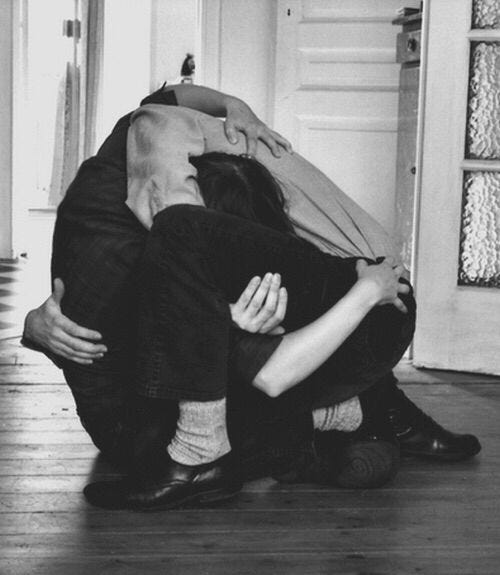
Eros is not satisfied by static possession because it is fundamentally animated by this movement toward disclosure, toward encounter, toward what exceeds complete comprehension. Toward the continual unveiling of what cannot be fully exhausted or finalized. Which is why desire dies so quickly under total overfamiliarity, complete transparency, or rigid certainty. Eros requires some remaining horizon—some sense that another person, the world, even the self, still exceeds what is already known.
Eros reorganizes all perception and so the world itself becomes charged. Things stop appearing as neutral objects and begin shimmering with significance, density, and charge. The condensation slipping down a cold martini glass while you wait for your date to arrive. A stranger brushing past you on the subway leaving behind the faint trace of honeysuckle. A line from a novel that seems written precisely for that private grief you had not yet managed to articulate. The bruised purple underside of evening clouds over a grocery store parking lot. Your apartment, which yesterday felt dulled by routine and chores, now appears tender, inhabited, full of evidence that a life is being lived. Mid-argument, your partner sneezes and suddenly all your irritation collapses at the sight of this fragile, breathing animal you love. Eros restores a kind of perceptual depth perception. The world stops feeling distant and starts feeling encounterable. The ordinary world regains dimensionality and vividness is restored to existence.
Erotic Intelligence
It is one thing to say phenomenology asks us to return to lived experience before abstraction hardens over it; it is another thing entirely to do that at 9:47 p.m. with the person whose dental floss is on the nightstand and whose stories you have heard enough times to silently mouth the punchline.
Intimacy is the great stress test of phenomenological life because it asks whether we can remain in contact with what is most familiar without deadening it into the already-known. Whether we can continue to encounter what we also depend on. Whether eros can survive not only distance and longing, but proximity, repetition, groceries, shared calendars, resentment, bedtime routines, and the thousand tiny domestic facts that threaten to turn a living subject into household infrastructure.
This week marks the twentieth anniversary of Esther Perel’s Mating in Captivity (if you haven’t read it, you absolutely should; if you have, it’s one of those books that deepens on rereading). And despite two decades of technological acceleration, algorithmic living, optimized communication, productivity culture, worldwide loneliness, and the strange administrative exhaustion of modern adulthood, people remain haunted by essentially the same question: how do we remain alive to one another after familiarity sets in? How do we continue encountering rather than merely recognizing?
What Esther repeatedly returns to is the notion that desire requires a certain perceptual aliveness. It is the capacity to experience another person as exceeding your existing knowledge of them. To resist reducing them to role, utility, predictability, or accumulated information. In this sense, Mating in Captivity becomes something so much larger than a book about sex or relationships. It becomes a deeply practical phenomenology of intimacy: a study in how to keep another person alive before you.
Not merely “the husband.” “The wife.” “The co-parent.” “The person who forgot to switch the laundry again.” But a living, shifting, partly unknowable consciousness. Someone with moods you cannot fully predict. Contradictions you cannot entirely resolve. Fantasies, fears, memories, private interior weather systems still unfolding beyond your management of them. Someone who can still surprise you, because no person can ever be fully converted into knowledge.
Phenomenology asks us to suspend the ready-made explanation long enough to return to the phenomenon itself. Esther asks us to do this with the person sleeping beside us. To proverbially bracket (however briefly!) the accumulated case file: the grievances, efficiencies, diagnoses, domestic shorthand, and defensive certainties through which long-term intimacy so often protects itself from surprise. Not to forget history, not to pretend we do not know what we know, but to loosen the grip of finality. To allow the other to appear again as a subject rather than a settled fact.
Because the death of eros is often not explosive betrayal or dramatic catastrophe. More often, it is perceptual deadening. The gradual conversion of another person from living subject into stabilized concept. The point at which you stop looking because you think you already know. You know what they’ll say. You know what they’ll order. You know how they’ll react. You know the face they make when annoyed, the little sigh before disagreement, the way they enter a room when carrying bad news. And of course, some of this knowing is in fact intimacy. Some of it is tenderness. But some of it becomes embalming fluid. The beloved is preserved so thoroughly inside your idea of them that they no longer get to arrive.
That is the paradox Esther keeps returning to: love seeks closeness, but desire requires alterity. Love wants continuity, reliability, “text me when you land.” Desire wants distance, mystery, the charge of the other as other. The task is not to choose one over the other, but to cultivate the strange double vision of mature eros: to know someone deeply while still making room for their unknowability. To build a life together without turning that life into a locked room.
This is also why eros, in Esther’s framework, is never merely about sex. It is one of the places where the whole relational field concentrates and reveals itself: power, shame, play, generosity, withholding, control, imagination, resentment, freedom, dependency, repair. Old humiliations surface beside longing. Control collides with vulnerability. The body leaks truths the polished self would often prefer remain managed. A hesitation before touch. The sudden disappearance of spontaneity. The ache of wanting to be wanted without having to ask. The grief of feeling emotionally unseen while physically held.
The bedroom becomes then phenomenological pressure point where the entire relationship reveals its hidden architecture. Not only “Do we desire each other?” but “Can we still experience each other as vividly alive rather than psychologically filed away?” Can we remain curious in the face of familiarity? Can we risk being seen in our wanting rather than performing competence around it? Can we tolerate the terrifying fact that another person will never be fully containable by our narratives about them?
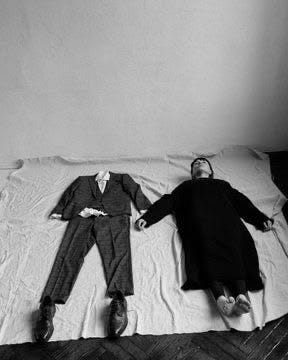
Because erotic life is rarely destroyed by lack of information. More often it dies beneath overfamiliarity, management, certainty, and the slow conversion of encounter into administration. The beloved becomes role before they remain phenomenon. And the body, which once felt like a site of discovery, begins to feel procedural.
A dear friend told me, almost a decade ago now, that she had given Mating in Captivity to her husband like a pearl made of paper. On the surface, it could have looked like a request for more and better sex—that was certainly how her husband interpreted it—but beneath that was a much more vulnerable plea: Would you meet me in my interiority? Would you be interested in encountering me? Would you stay curious about me? Unfortunately, her now ex-husband declined the invitation.
And perhaps one of the deepest erosions a person can experience is having their aliveness—their existence as other, as profound phenomena—continually treated as excessive and inconsequential at once. When curiosity, longing, intensity, imagination, sensuality, vitality—that current moving through them—is repeatedly met with diminishment, embarrassment, indifference, or management. When the most alive parts of someone are treated as “too much” while also not important enough to truly engage. This is not only a sexual wound. It’s an ontological one. It is the wound of offering the place where you feel most real and having it treated like an inconvenience.
This friend of mine possesses an immense aliveness: appetite, intelligence, sensitivity, humor, erotic vitality in the broadest and most beautiful sense. And what devastated her was not simply heartbreak but the repeated implication that the very qualities making her most alive were a burden rather than worthy of encounter. As though the current moving through her—that brilliant animating force—could be ignored without consequence.
“Eroticism thrives in the space between the self and the other.”
-Esther Perel, Mating in Captivity
To lose eros to lose then, is not simply to lose passion. It is to lose the feeling of being addressed by the world. To stop feeling that life is asking something of you, offering something to you, arriving with texture and heat and risk. It is the delightful discipline of re-encounter. The willingness to look again at what has become familiar and admit that you have not exhausted it. The person beside you is not a solved problem. The world is not a dead object. Eros begins there: in the shock of realizing that what you thought you knew is still, somehow, alive.
To live phenomenologically is not to reject knowledge or familiarity but to resist allowing them to become totalizing. It is to preserve some living corridor between oneself and the world through which surprise, revelation, beauty, grief, desire, and encounter can still travel. Eros is the animating force that keeps things from getting phenomenologically unfinished. The force that returns depth to what familiarity threatens to flatten. Suddenly the glass of wine is no longer “a drink” but mineral, memory, weather, earth, time. The café becomes less a waypoint than a small sanctuary of human rhythm. The subway car fills again with synchronistic private lives. The beloved ceases being merely “your partner” and becomes once more this astonishing, unknowable consciousness unfolding beside you: capable of wounding you, surprising you, transforming you.
Eros restores the world’s dimensionality. It allows reality—no, truth!—to gleam again at the edges instead of lying there fully explained. And maybe being alive, in the deepest sense, is nothing more—and nothing less—than remaining vulnerable to encounter.

stunning. thinking about this in concert with carson’s eros the bittersweet
"A partner is not phenomenologically reducible to “the person you are with.” They are the body you unconsciously orient toward in sleep. The footsteps you recognize before the door even opens. The accumulated archive of glances, tensions, private jokes, embraces, disappointments, grief, tendernesses. The smell of a sweet neck. The ongoing shock that another consciousness—Confusing! Contradictory! Inexplicable!—continues unfolding beside you despite days, months, years, decades of proximity."
That's beautiful.
I got hip to phenomenology, and Husserl, through Camus, who references (and argues against) him extensively in his "Myth of Sisyphus." And I found it fascinating enough to buy Husserl's book, "Ideas: General Introduction to Pure Phenomenology."
I think it's a worthwhile endeavor. I have a note in my home office that reads, "Make it your constant practice to follow along with the way each thing is of itself"--which, truthfully, stems more from my Taoist beliefs, but there is certainly a lot of crossover here.